12-night Discovering Greenland – From New York To Nuuk
HX Expeditions · MS Fridtjof Nansen · 12 nights · Reykjavik–Nuuk

Special Offer The Signature Collection

From $7,788 per person
The Signature Collection Sailings offer Exceptional Value and Exclusive Amenities.
What's Included
- Cruise
- Meals
- Free Wi-Fi
- Entertainment
Itinerary
Jun 1 Reykjavik
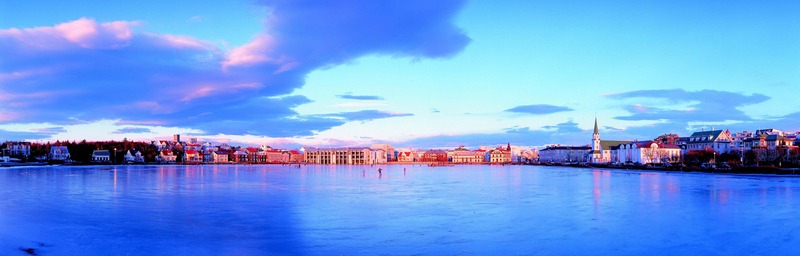
The fire, frost and water symbolized by the red, white and blue of Iceland’s flag are manifested in this land. Reykjavik, or Smoky Bay, was so named in 874 A.D. by Ingolf Arnarson when he sighted the numerous hot springs on the Seltjarnarnes Peninsula. Today this remarkably pollution-free city is wrapped around a sweeping bay and has managed to retain its charming Old-World atmosphere. A pastiche of red-blue-and green-roofed houses together with the tall gray tower of Hallgrim’s Church dominate the skyline. In Old Town, many of the wooden buildings have been lovingly restored and stand side by side with modern timber and concrete structures. There are fine museums and art galleries; historic pubs present activity in late afternoon. The beautiful countryside outside of Reykjavik includes such natural wonders as volcanoes, geysers, glaciers, mountains and spectacular waterfalls.
Excursions
Reykjavik - The Golden Circle - FD Tour
— Optional Private Excursions
Capture the ‘The Big Three’ on this classic excursion to Gullfoss Waterfall, Geysir Strokkur and Thingvellir National Park.

Reykjavik - Bathing in the Blue Lagoon - HD Tour
— Optional Private Excursions
Here guests can enjoy a relaxing bathe in the surreal milky waters of Iceland’s most famous of geothermal Spas – The Blue Lagoon. So what exactly IS the Blue Lagoon? Well, it is Iceland's most unique and popular attraction. Guests will enjoy bathing and relaxing in Blue Lagoon geothermal seawater, known for its positive effects on the skin. A visit to the spa promotes harmony between body, mind and spirit, and enables one to soak away the stresses of modern life. The spa's guests rekindle their relationship with nature, soak up the scenic beauty and enjoy breathing the clean, fresh air. In addition to bathing in the lagoon guests have access to a sauna with a view of the lagoon, a sauna with white walls that resemble silica mud and a cozy steam bath carved into a lava cave. Of course, guests bathing in the milky waters of the lagoon have easy access to the famous white silica mud, an essential part of this ultimate in spa experiences.
Tour Duration: 3-4 hours
Tour can operate: Morning or Afternoon
Wheelchair Accessible: Yes
Physical Activy Level: Easy
Included: Private car with driver-guide, Blue Lagoon Comfort Experience (entrance fee, towel rental, Silica Mud Mask, choice of one drink at the Lagoon.) Pick up/drop off at the port.
Not Included: Meals
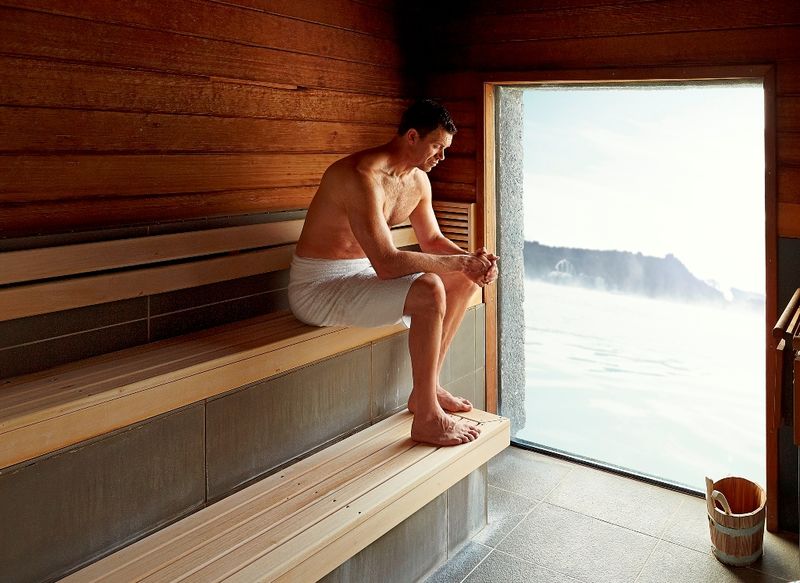
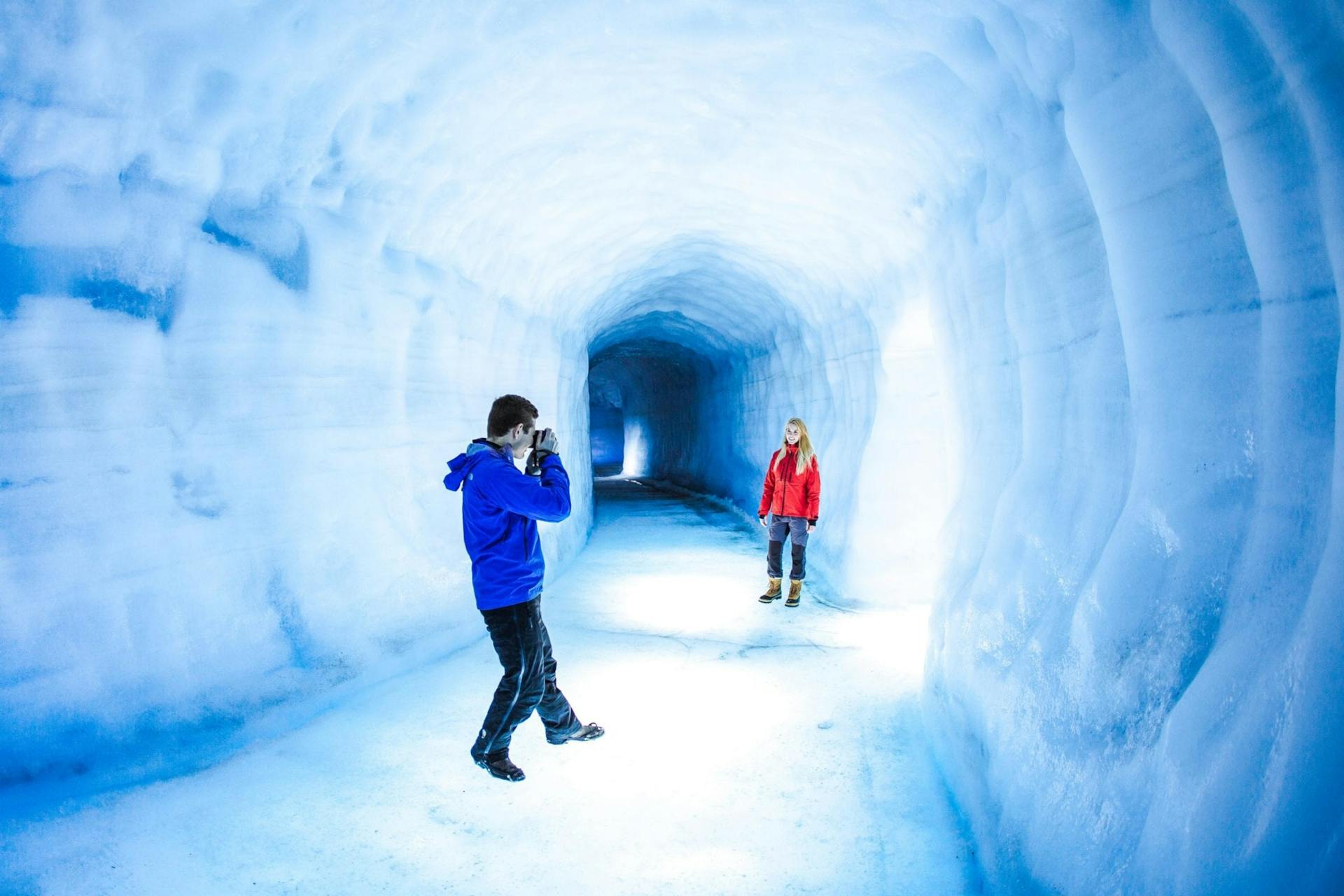
Reykjavik - Langjökull Glacier & the Ice Tunnel
— Optional Private Excursions
Wear/Bring: Warm clothes for cold weather, waterproof/warm coat and suitable footwear
Tour Duration: 11-12 hours
Reykjavik Highlights - HD Tour
— Optional Private Excursions
Add ons:
- A visit to the open-air museum of Arbaer Travel back to Reykjavik’s past with a visit to a fascinating collection of town and farm buildings from the last few centuries.
- A visit to the Pearl vantage point. The new Perlan is an exciting interactive exhibition about Iceland’s nature and geology. Entrance includes the “Wonders of Iceland Exhibit (including Glaciers and Ice Cave) and the 360° Observation Deck.
- Hallgrimskirkja Church Climb the tower of this iconic church for a beautiful view over the city and sea. (Tower access closed during church services and some events)
- A visit to the National museum The National Museum of Iceland’s permanent exhibition, Making of a Nation - Heritage and History in Iceland, provides insight into the history of the Icelandic nation from the Norse Settlement to the present day. The exhibition includes about 2.000 objects.
Reykjavik Blue Lagoon experience with transfers – 4 Hours
— Optional Private Excursions
In the southwest corner of Iceland is the Reykjanes peninsula, less than 1-hour drive from the capital or 20-minute drive from Keflavik International Airport.
There the Mid-Atlantic Ridge comes ashore. The nature is magnificent. Various volcanic formations are found on Reykjanes Peninsula, such as mountains and hills chiefly made of volcanic tuff, large and small lava flows plus different types of volcanoes and volcanic edifices. The Reykjanes peninsula volcanic zone is a direct continuance of the North Atlantic Ridge that surfaces from the ocean at Reykjanes, and it is home to many important geological formations, some of which are utterly unique, including numerous types of volcanoes, naturally carved pools, craters, and geothermal pools.
Few things are cozier than relaxing in a hot pool in the middle of nature. Iceland has an abundance of easily accessible natural pools, but it is perhaps the Blue Lagoon the most spectacular of them all.
The Blue Lagoon was founded in 1992. Its specialty is the geothermal sea, which is two thirds of salt water and one third of fresh water. It is found at a depth of up to 2000 meters and is led by a pipe from the source to the lagoon where guests can enjoy it and relax. It is rich in minerals, silica, and algae, which is the basis of all skin products in the Blue Lagoon.
National Geographic has chosen the Blue Lagoon as one of the 25 wonders of the world. The Blue Lagoon has developed into an experience company based on spas, research and development, skin care, hotels, and restaurants
Treat yourself and experience it during your stay in Reykjavik. Alternatively, this is the ultimate way to unwind and chill after or prior a long-haul flight when you arrive of depart to / from Iceland.
What to expect: Landmarks of natural wonders of the country, insight into geology, relaxation.
Basis: Private tour.
Start / End: City center Hotel or address or Keflavik International Airport.
Duration: 4 hours.
Vehicle: 01st Class.
Guide: English-speaking driver guide. Other languages on request.
Entrances: Comfort entrance to Blue Lagoon with use of the towel, mud mask and first drink at your choice.
Meals: None.
Physical activity level: Grade Easy. Walking required over uneven surfaces.
Wheelchair accessible: NO
Tour operates: morning, afternoon.
Notes: Tour program may be reversed for logistic / planning purposes.
Reykjavik Blue Lagoon & Reykjanes Peninsula – 8 Hours
— Optional Private Excursions
In the southwest corner of Iceland is the Reykjanes peninsula, less than 1-hour drive from the capital or 20-minute drive from Keflavik International Airport.
Explore the Reykjanes peninsula and visit the Blue Lagoon. This geothermal area includes solfataras, fumaroles, mud pots and hot springs and sulphur was mined there early in the 18th century and then again in the 19th century. Gunnuhver is the largest mud geyser in Iceland, about 20 metres wide. Grindavik, the small fishing village with about 3000 inhabitants, has a long history, including when pirates from Morocco and Algeria arrived in the 17th century and took fifteen residents to sell as slaves. Additionally, we will take in the magnificent coastline and dramatic breaking waves by the Reykjanes lighthouse and “The Bridge Between the Continents” which connects the American and Eurasian tectonic plates.
Few things are cozier than relaxing in a hot pool in the middle of nature. Iceland has an abundance of easily accessible natural pools, but it is perhaps the Blue Lagoon the most spectacular of them all.
Treat yourself and experience it during your stay in Reykjavik. Alternatively, this is the ultimate way to unwind and chill after or prior a long-haul flight when you arrive of depart to / from Iceland.
,
What to expect: Landmarks of natural wonders of the country, insight into local history and geology, relaxation. Coastal villages.
Basis: Private tour.
Start / End: City center Hotel or address or Keflavik International Airport.
Duration: 8 hours.
Vehicle: 01st Class.
Guide: English-speaking driver guide. Other languages on request.
Entrances: Comfort entrance to Blue Lagoon with use of the towel, mud mask and first drink at your choice.
Meals: None.
Physical activity level: Grade Easy. Walking required over uneven surfaces.
Wheelchair accessible: NO
Tour operates: morning, afternoon.
Notes: Tour program may be reversed for logistic / planning purposes.
Reykjavik Golden Circle Classic – 8 Hours
— Optional Private Excursions
Iceland’s main attraction is the Golden Circle, it combines most of what Iceland has to offer, beautiful landscape, powerful geysers and the most magnificent waterfall. The highlights of the tour are Thingvellir National Park, the Geysir area and the Gullfoss waterfall.
This tour is designed to let you explore the highlights of Golden Circle route. We will show you sights that are not marked on a map, and only the locals know about. We will start the tour by heading to Þingvellir, a designated UNESCO World Heritage Site.
Thingvellir, 50 km (31 miles) to the east of Reykjavík, is the national shrine of Iceland and its most historic site, and one of its most beautiful places. The oldest existing parliament in the world first met here in AD930. It has always been the focal point for the country, and whenever a major event is to be celebrated, thousands of people come here.
We continue the Golden Circle by heading to the famous Geysir geothermal area which is home to The Great Geysir and its active sidekick Strokkur! Although the original Geysir is not predictably active, its neighbour, Strokkur, will erupt every 5-7 minutes - so have your camera ready.
We then drive a few minutes down the road to the most famous part of the Golden Circle: Gullfoss, or “Golden Falls “. To stand at Gullfoss and bask in the beauty and the wonder of nature is an uplifting experience. One certainly feels energized after this tour and contact with stunning nature.
During the tour, a delicious lunch will be offered at the local geothermal tomato farm, a unique venue for a special lunch.
,What to expect: Stunning scenery, landmarks of the natural wonders of the country, insight into local history.
Basis: Private tour.
Start / End: City center Hotel or address.
Duration: 8 hours.
Vehicle: 01st Class.
Guide: English-speaking driver guide. Other languages on request.
Entrances: Greenhouse visit.
Meals: Lunch at Geothermal farm.
Physical activity level: Grade Easy. Walking required over uneven surfaces.
Wheelchair accessible: no
Tour can operate: morning and afternoon.
Notes: Tour program may be reversed for logistic / planning purposes.
Reykjavik South Shore Adventure – 10 Hours
— Optional Private Excursions
We take you along the south coast of Iceland, one of the country’s most scenic regions, as far as Vík, a charming village surrounded by high beautiful bird cliffs.
Among the stops on this tour are at the gorgeous Seljalandsfoss and Skógafoss waterfalls, the Reynisfjara black sand beach, Dyrhólaey and Vik..
Driving through Vatnajökull National Park, established in 2008 covers 14,1% of Iceland and ranks as Europe's second largest. The unique qualities of Vatnajökull National Park are primarily its great variety of landscape features, created by the combined forces of rivers, glacial ice, and volcanic and geothermal activity. Vatnajökull is Europe's largest glacier.
The south side of Vatnajökull is characterized by many high, majestic mountain ridges, with outlet glaciers descending between them onto the lowlands. Sheltered by the high ice, the vegetated oasis of Skaftafell overlooks the black sands deposited to its west by the river Skeiðará.
Dyrhólaey is a 120-metre high promontory, not far from Vík. The place got its name from the massive arch that the sea has eroded from the headland. (The name literally means "door-hole"). There are also amazing rock formations all along the Birdlife here is abundant, with puffins and eider ducks being the most common species in the area. The lighthouse on the top of the cliff stands impressive and stoic in this often very windy area.
What to expect: Stunning scenery, landmarks of the natural wonders of the country, insight into local history and geology. Coastal villages.
Basis: Private tour.
Start / End: City center Hotel or address.
Duration: 10 hours.
Vehicle: 01st Class.
Guide: English-speaking driver guide. Other languages on request.
Entrances: None.
Meals: None.
Physical activity level: Grade Easy. Walking required over uneven surfaces.
Wheelchair accessible: no
Tour can operate: morning and afternoon.
Notes: Tour program may be reversed for logistic / planning purposes.
Reykjavik Food tour – 3 hs
— Optional Private Excursions
Experience the foodie side of the Icelandic capital!
On this food walking tour you will try the truly authentic food from Iceland and also get a nice orientation of Reykjavik city.
Some of the highlights of this tour are the visit of Reykjavik’s oldest restaurant, a stop at a gastropub, and of course, the possibility of trying a variety of local dishes. Among the specialties included in this tour, we can mention the special Lamb soup, the Unique Icelandic Lamb Hot dog, Lobster soup, and a Skyr Dessert.
You also get tips on what to eat, drink and where to have fun for the rest of your stay in Reykjavik.
Basis: Private tour.
Duration: 3 hours walking tour.
Start / End: Ingólfur Square/City Center.
Vehicle: None.
Guide: English-speaking. Other languages on request.
Entrances: None.
Meals: Tastings. Icelandic Traditional food is based on meat, fish and dairy, but other options may be available.
Physical activity level: Grade Easy. Walking required over uneven surfaces.
Wheelchair accessible: NO
Tour operates: morning, afternoon.
Notes: Tour program may be reversed for logistic / planning purposes. This tour is not offered on public holidays.
Reykjavik Walking tour – 3,5 hours
— Optional Private Excursions
Reykjavík is a city of bold contrasts. The capital of Iceland is small but cosmopolitan and small-town; vibrant and sophisticated; young-at-heart and yet full of history. In this tour you will walk around the city and discover the main sights.
Together with your local guide, you will pass by the Hallgímskirkja church, the highest and probably most iconic building in town, as well as the Dome Church, which is Reykjavik’s Lutheran Cathedral and the bishop’s place in Iceland. The Dome Church is located downtown, next to the Alþingi, house of parliament.
You will see other emblematic sites like the “Sun Voyager” sculpture created by Icelandic sculptor Jon Gunnar Arnason. This gleaming steel sculpture is located on Reykjavik’s splendid waterfront and resembles a Viking long-ship, the ‘Solfar’ or ‘Sun Voyager.’ You will also see the modern building Harpa, a cultural and social centre in the heart of the city, and the Old Harbour.
Basis: Private tour.
Duration: 3,5 hours walking tour.
Start / End: City.
Vehicle: None.
Guide: English-speaking. Other languages on request.
Entrances: None.
Meals: None.
Physical activity level: Grade Easy. Walking required over uneven surfaces.
Wheelchair accessible: NO
Tour operates: morning, afternoon.
Notes: Tour program may be reversed for logistic / planning purposes.
Jun 2 Denmark Strait
Jun 3 Denmark Strait
Jun 4 South Greenland
The island's agricultural center will appeal most to visitors seeking outdoor activities, from hiking to serious rock climbing. Field ice (floating sheets of ice—not to be confused with icebergs) drift in this area in spring and summer, and they occasionally impede vessels that carry supplies to the villages.
Igaliku—This tiny village (known in ancient times as Gardar), shielded by the mountains and blessed with good soil, is in a sheep-raising and vegetable-growing area. It was the main religious center for the Vikings in Greenland, and you can still see the ruins of their cathedral, which was built in the 1100s. Hvalsey Church, one of Greenland's best Viking ruins, is five hours away from Igaliku by boat. 305 mi/490 km southeast of Nuuk.
Nanortalik—This town of 1,500 offers well-kept gardens and scenic views of the surrounding granite mountains. The water around Nanortalik is good for kayaking, and hunters returning in their kayaks with their catch are a year-round sight. In May and June, visitors can witness the feverish activity caused by migrating hooded seals. A good number of the townsfolk move to old hunting grounds in the skerries (small rocky reefs or islands), where they live in tents and mud huts while hunting the seals. Attractions within the town include a churchyard from the colonial period (built in 1916) and a museum (housed in old buildings once used by the Royal Greenland Trade Department). Greenland's largest wooded area lies six hours on foot from the nearby settlement of Tasiusaq. Nanortalik is 350 mi/565 km southeast of Nuuk.
Narsaq—Set against a mountain backdrop, this village offers several attractions, including a museum (equipment and products from famous local printer and publisher Frederik Hoegh); the home of Henrik Lund (a priest and poet who wrote the national anthem); the Krystal Palace (a workshop specializing in modeling local stones); and Narsaq Foto (where John Rasmussen tells the story of life in South Greenland through photography). At Kayak Harbor, you'll see some old kayaks, icebergs and hunters returning with seals. At the nearby mountain of Kvanefjeld, you can hunt for tuttupit (gemstones), and uranium deposits have also been found in the area. Narsaq is 295 mi/475 km southeast of Nuuk.
Narsarsuaq—This airport, which was founded in 1941 as a U.S. air base—personnel departed shortly after World War II—is the gateway to the beautiful Skov and Eiriks fjords and one of the Greenland airports reached by international flights. We highly recommend the area: It's refreshing to walk through the town and its non-ice-covered surroundings of plains, dry riverbeds and wildflowers against a backdrop of glaciers and rugged, barren mountains (nearby Mount Igdlerfik can be climbed in the summer).
Just a half-hour away by boat is Qassiarsuk (Brattahlid), a village that occupies the site of the Viking settlement founded by Eric the Red in the 900s. The ruins of Viking houses and a reconstructed church can be visited. Other trips from Narsarsuaq include a boat excursion down the Qooroq Fjord to Qooqqut Sermiat Glacier (a half-day boat trip) and a hike to Kiagtuut Sermiat Glacier (a six- to eight-hour trip). Narsarsuaq has one big hotel and a youth hostel. 300 mi/480 km southeast of Nuuk.
Qaqortoq (Julianehab)—With its multicolored houses perched on a mountainside overlooking icebergs, Qaqortoq rates as one of the most beautiful towns on the island (with very friendly people). Several old buildings sit around the square, which boasts the only fountain in Greenland. The Cooper's Shop dates from 1781. A museum displays Inuit utensils and Viking artifacts. Behind the museum, there's an exact copy of a turf house from the beginning of the 1900s. The town tannery processes skins and furs and sells high-quality fur coats and hats around the world: Tours of the tannery can be arranged. Other interesting sites include the Culture House (art exhibits) and the old church (a beautiful red wood building).
One popular excursion from Qaqortoq is the boat ride to Hvalsey Church, the most famous and best-preserved Viking ruin in Greenland. On the nearby island of Uunartoq, you can hike to several hot-spring pools—at 95 F/35 C, they are suitable for a dip. Lounging in the warm water while icebergs crash about in the nearby inlet is a rather bizarre experience—but one you won't forget. Qaqortoq is 300 mi/485 km southeast of Nuuk.
Jun 5 South Greenland
The island's agricultural center will appeal most to visitors seeking outdoor activities, from hiking to serious rock climbing. Field ice (floating sheets of ice—not to be confused with icebergs) drift in this area in spring and summer, and they occasionally impede vessels that carry supplies to the villages.
Igaliku—This tiny village (known in ancient times as Gardar), shielded by the mountains and blessed with good soil, is in a sheep-raising and vegetable-growing area. It was the main religious center for the Vikings in Greenland, and you can still see the ruins of their cathedral, which was built in the 1100s. Hvalsey Church, one of Greenland's best Viking ruins, is five hours away from Igaliku by boat. 305 mi/490 km southeast of Nuuk.
Nanortalik—This town of 1,500 offers well-kept gardens and scenic views of the surrounding granite mountains. The water around Nanortalik is good for kayaking, and hunters returning in their kayaks with their catch are a year-round sight. In May and June, visitors can witness the feverish activity caused by migrating hooded seals. A good number of the townsfolk move to old hunting grounds in the skerries (small rocky reefs or islands), where they live in tents and mud huts while hunting the seals. Attractions within the town include a churchyard from the colonial period (built in 1916) and a museum (housed in old buildings once used by the Royal Greenland Trade Department). Greenland's largest wooded area lies six hours on foot from the nearby settlement of Tasiusaq. Nanortalik is 350 mi/565 km southeast of Nuuk.
Narsaq—Set against a mountain backdrop, this village offers several attractions, including a museum (equipment and products from famous local printer and publisher Frederik Hoegh); the home of Henrik Lund (a priest and poet who wrote the national anthem); the Krystal Palace (a workshop specializing in modeling local stones); and Narsaq Foto (where John Rasmussen tells the story of life in South Greenland through photography). At Kayak Harbor, you'll see some old kayaks, icebergs and hunters returning with seals. At the nearby mountain of Kvanefjeld, you can hunt for tuttupit (gemstones), and uranium deposits have also been found in the area. Narsaq is 295 mi/475 km southeast of Nuuk.
Narsarsuaq—This airport, which was founded in 1941 as a U.S. air base—personnel departed shortly after World War II—is the gateway to the beautiful Skov and Eiriks fjords and one of the Greenland airports reached by international flights. We highly recommend the area: It's refreshing to walk through the town and its non-ice-covered surroundings of plains, dry riverbeds and wildflowers against a backdrop of glaciers and rugged, barren mountains (nearby Mount Igdlerfik can be climbed in the summer).
Just a half-hour away by boat is Qassiarsuk (Brattahlid), a village that occupies the site of the Viking settlement founded by Eric the Red in the 900s. The ruins of Viking houses and a reconstructed church can be visited. Other trips from Narsarsuaq include a boat excursion down the Qooroq Fjord to Qooqqut Sermiat Glacier (a half-day boat trip) and a hike to Kiagtuut Sermiat Glacier (a six- to eight-hour trip). Narsarsuaq has one big hotel and a youth hostel. 300 mi/480 km southeast of Nuuk.
Qaqortoq (Julianehab)—With its multicolored houses perched on a mountainside overlooking icebergs, Qaqortoq rates as one of the most beautiful towns on the island (with very friendly people). Several old buildings sit around the square, which boasts the only fountain in Greenland. The Cooper's Shop dates from 1781. A museum displays Inuit utensils and Viking artifacts. Behind the museum, there's an exact copy of a turf house from the beginning of the 1900s. The town tannery processes skins and furs and sells high-quality fur coats and hats around the world: Tours of the tannery can be arranged. Other interesting sites include the Culture House (art exhibits) and the old church (a beautiful red wood building).
One popular excursion from Qaqortoq is the boat ride to Hvalsey Church, the most famous and best-preserved Viking ruin in Greenland. On the nearby island of Uunartoq, you can hike to several hot-spring pools—at 95 F/35 C, they are suitable for a dip. Lounging in the warm water while icebergs crash about in the nearby inlet is a rather bizarre experience—but one you won't forget. Qaqortoq is 300 mi/485 km southeast of Nuuk.
Jun 6 South Greenland
The island's agricultural center will appeal most to visitors seeking outdoor activities, from hiking to serious rock climbing. Field ice (floating sheets of ice—not to be confused with icebergs) drift in this area in spring and summer, and they occasionally impede vessels that carry supplies to the villages.
Igaliku—This tiny village (known in ancient times as Gardar), shielded by the mountains and blessed with good soil, is in a sheep-raising and vegetable-growing area. It was the main religious center for the Vikings in Greenland, and you can still see the ruins of their cathedral, which was built in the 1100s. Hvalsey Church, one of Greenland's best Viking ruins, is five hours away from Igaliku by boat. 305 mi/490 km southeast of Nuuk.
Nanortalik—This town of 1,500 offers well-kept gardens and scenic views of the surrounding granite mountains. The water around Nanortalik is good for kayaking, and hunters returning in their kayaks with their catch are a year-round sight. In May and June, visitors can witness the feverish activity caused by migrating hooded seals. A good number of the townsfolk move to old hunting grounds in the skerries (small rocky reefs or islands), where they live in tents and mud huts while hunting the seals. Attractions within the town include a churchyard from the colonial period (built in 1916) and a museum (housed in old buildings once used by the Royal Greenland Trade Department). Greenland's largest wooded area lies six hours on foot from the nearby settlement of Tasiusaq. Nanortalik is 350 mi/565 km southeast of Nuuk.
Narsaq—Set against a mountain backdrop, this village offers several attractions, including a museum (equipment and products from famous local printer and publisher Frederik Hoegh); the home of Henrik Lund (a priest and poet who wrote the national anthem); the Krystal Palace (a workshop specializing in modeling local stones); and Narsaq Foto (where John Rasmussen tells the story of life in South Greenland through photography). At Kayak Harbor, you'll see some old kayaks, icebergs and hunters returning with seals. At the nearby mountain of Kvanefjeld, you can hunt for tuttupit (gemstones), and uranium deposits have also been found in the area. Narsaq is 295 mi/475 km southeast of Nuuk.
Narsarsuaq—This airport, which was founded in 1941 as a U.S. air base—personnel departed shortly after World War II—is the gateway to the beautiful Skov and Eiriks fjords and one of the Greenland airports reached by international flights. We highly recommend the area: It's refreshing to walk through the town and its non-ice-covered surroundings of plains, dry riverbeds and wildflowers against a backdrop of glaciers and rugged, barren mountains (nearby Mount Igdlerfik can be climbed in the summer).
Just a half-hour away by boat is Qassiarsuk (Brattahlid), a village that occupies the site of the Viking settlement founded by Eric the Red in the 900s. The ruins of Viking houses and a reconstructed church can be visited. Other trips from Narsarsuaq include a boat excursion down the Qooroq Fjord to Qooqqut Sermiat Glacier (a half-day boat trip) and a hike to Kiagtuut Sermiat Glacier (a six- to eight-hour trip). Narsarsuaq has one big hotel and a youth hostel. 300 mi/480 km southeast of Nuuk.
Qaqortoq (Julianehab)—With its multicolored houses perched on a mountainside overlooking icebergs, Qaqortoq rates as one of the most beautiful towns on the island (with very friendly people). Several old buildings sit around the square, which boasts the only fountain in Greenland. The Cooper's Shop dates from 1781. A museum displays Inuit utensils and Viking artifacts. Behind the museum, there's an exact copy of a turf house from the beginning of the 1900s. The town tannery processes skins and furs and sells high-quality fur coats and hats around the world: Tours of the tannery can be arranged. Other interesting sites include the Culture House (art exhibits) and the old church (a beautiful red wood building).
One popular excursion from Qaqortoq is the boat ride to Hvalsey Church, the most famous and best-preserved Viking ruin in Greenland. On the nearby island of Uunartoq, you can hike to several hot-spring pools—at 95 F/35 C, they are suitable for a dip. Lounging in the warm water while icebergs crash about in the nearby inlet is a rather bizarre experience—but one you won't forget. Qaqortoq is 300 mi/485 km southeast of Nuuk.
Jun 7 South Greenland
The island's agricultural center will appeal most to visitors seeking outdoor activities, from hiking to serious rock climbing. Field ice (floating sheets of ice—not to be confused with icebergs) drift in this area in spring and summer, and they occasionally impede vessels that carry supplies to the villages.
Igaliku—This tiny village (known in ancient times as Gardar), shielded by the mountains and blessed with good soil, is in a sheep-raising and vegetable-growing area. It was the main religious center for the Vikings in Greenland, and you can still see the ruins of their cathedral, which was built in the 1100s. Hvalsey Church, one of Greenland's best Viking ruins, is five hours away from Igaliku by boat. 305 mi/490 km southeast of Nuuk.
Nanortalik—This town of 1,500 offers well-kept gardens and scenic views of the surrounding granite mountains. The water around Nanortalik is good for kayaking, and hunters returning in their kayaks with their catch are a year-round sight. In May and June, visitors can witness the feverish activity caused by migrating hooded seals. A good number of the townsfolk move to old hunting grounds in the skerries (small rocky reefs or islands), where they live in tents and mud huts while hunting the seals. Attractions within the town include a churchyard from the colonial period (built in 1916) and a museum (housed in old buildings once used by the Royal Greenland Trade Department). Greenland's largest wooded area lies six hours on foot from the nearby settlement of Tasiusaq. Nanortalik is 350 mi/565 km southeast of Nuuk.
Narsaq—Set against a mountain backdrop, this village offers several attractions, including a museum (equipment and products from famous local printer and publisher Frederik Hoegh); the home of Henrik Lund (a priest and poet who wrote the national anthem); the Krystal Palace (a workshop specializing in modeling local stones); and Narsaq Foto (where John Rasmussen tells the story of life in South Greenland through photography). At Kayak Harbor, you'll see some old kayaks, icebergs and hunters returning with seals. At the nearby mountain of Kvanefjeld, you can hunt for tuttupit (gemstones), and uranium deposits have also been found in the area. Narsaq is 295 mi/475 km southeast of Nuuk.
Narsarsuaq—This airport, which was founded in 1941 as a U.S. air base—personnel departed shortly after World War II—is the gateway to the beautiful Skov and Eiriks fjords and one of the Greenland airports reached by international flights. We highly recommend the area: It's refreshing to walk through the town and its non-ice-covered surroundings of plains, dry riverbeds and wildflowers against a backdrop of glaciers and rugged, barren mountains (nearby Mount Igdlerfik can be climbed in the summer).
Just a half-hour away by boat is Qassiarsuk (Brattahlid), a village that occupies the site of the Viking settlement founded by Eric the Red in the 900s. The ruins of Viking houses and a reconstructed church can be visited. Other trips from Narsarsuaq include a boat excursion down the Qooroq Fjord to Qooqqut Sermiat Glacier (a half-day boat trip) and a hike to Kiagtuut Sermiat Glacier (a six- to eight-hour trip). Narsarsuaq has one big hotel and a youth hostel. 300 mi/480 km southeast of Nuuk.
Qaqortoq (Julianehab)—With its multicolored houses perched on a mountainside overlooking icebergs, Qaqortoq rates as one of the most beautiful towns on the island (with very friendly people). Several old buildings sit around the square, which boasts the only fountain in Greenland. The Cooper's Shop dates from 1781. A museum displays Inuit utensils and Viking artifacts. Behind the museum, there's an exact copy of a turf house from the beginning of the 1900s. The town tannery processes skins and furs and sells high-quality fur coats and hats around the world: Tours of the tannery can be arranged. Other interesting sites include the Culture House (art exhibits) and the old church (a beautiful red wood building).
One popular excursion from Qaqortoq is the boat ride to Hvalsey Church, the most famous and best-preserved Viking ruin in Greenland. On the nearby island of Uunartoq, you can hike to several hot-spring pools—at 95 F/35 C, they are suitable for a dip. Lounging in the warm water while icebergs crash about in the nearby inlet is a rather bizarre experience—but one you won't forget. Qaqortoq is 300 mi/485 km southeast of Nuuk.
Jun 8 Southwest Greenland
Jun 9 Southwest Greenland
Jun 10 Southwest Greenland
Jun 11 Nuuk Fjord
Jun 12 Nuuk Fjord
Jun 13 Nuuk
Nuuk was founded by the unfailingly optimistic Hans Egede - the Danish missionary with soul-conversions on his mind - who promptly named the settlement Good Hope. Today Nuuk is small by modern standards, with a total population of only 14,000. Despite a wealth of land and a paucity of people, Nuuk has insisted on housing the population in immense apartment blocks with imaginative names like Blok P - a kind of Gulag on ice - and the urban sprawl is now spreading out along the road to the airport. Kolonihavnen is a pleasant exception to the rest of Nuuk's Lego-city look: it's a picturesque 18th-century fishing village in the heart of Nuuk and gives some idea of what the town looked like before the industrial harbour was built. Nuuk's real attraction lies in its proximity to any number of excellent day hikes into the hinterland and the fabulous views from the tops of the nearby mountains. Organised tours, boat trips and the rental of equipment is easier from the capital.
Cabin Categories

Outside cabin
From $8,576 per person
- Large lower-deck cabin
- Window
- Double bed (optional twin)
- Bathrobes and slippers available on request
- Guests: 2
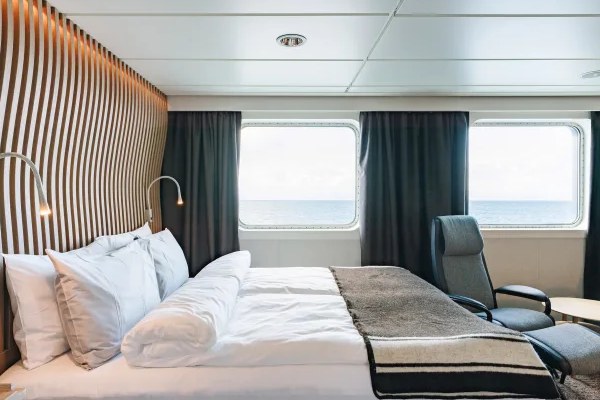
Wheelchair-accessible outside cabin
From $8,576 per person
- Large lower-deck cabin
- Wheelchair-accessible cabin, may be available for general booking
- Double bed (optional twin)
- Window
- Bathrobes and slippers available for request
- Guests: 2
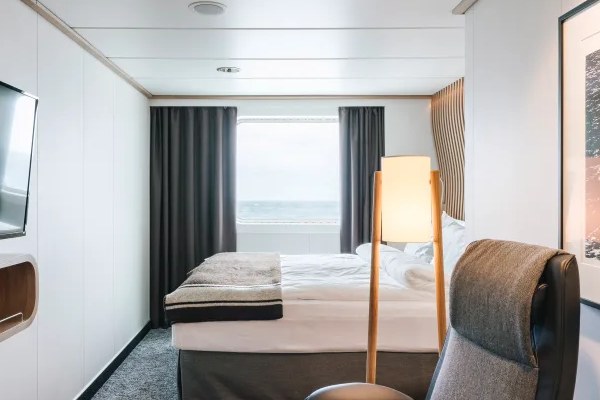
Outside cabin
From $7,788 per person
- Lower-deck cabin
- Window
- Double bed (optional twin)
- Some with sofa bed
- Bathrobes and slippers available on request
- Guests: up to 4

Outside cabin with balcony
From $9,650 per person
- Upper-deck cabin
- Private balcony
- Double bed (optional twin)
- Sofa bed or seating area
- Bathrobes and slippers available for request
- Guests: up to 4

Outside cabin with balcony
From $9,650 per person
- Upper-deck cabin
- Private balcony
- Double bed
- Bathrobes and slippers are available on request.
- Guests: 2
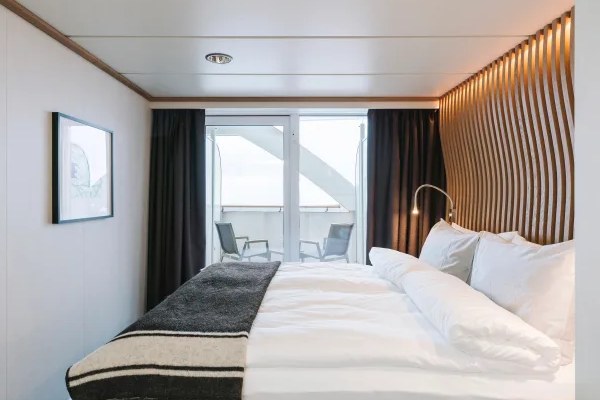
Outside cabin with balcony
From $9,149 per person
- Upper-deck cabin
- Private balcony (limited view)
- Double bed (optional twin)
- Some with sofa bed
- Bathrobes and slippers available for request
- Guests: up to 4

Wheelchair-accessible outside cabin with balcony
From $9,650 per person
- Upper-deck cabin
- Private balcony
- Wheelchair-accessible cabin, may be available for general booking
- Double bed
- Bathrobes and slippers are available on request.
- Guests: 2

Extra Large Suite
From $18,437 per person
- Extra-large upper-deck corner suite?
- Private balcony?
- Large windows?
- Double bed (optional twin)?
- Sofa bed?
- Bathrobes and slippers available on request??
- Guests: up to 4

Extra Large Suite
From $13,485 per person
- Extra-large lower-deck corner suite?
- Large windows?
- Seating area?
- Double bed (optional twin)?
- Double fold-down bed
- Bathtub?
- Bathrobes and slippers available on request?
- No balcony
- Guests: up to 4

Corner Suite
From $14,434 per person
- Upper-deck corner suite
- Private balcony
- Hot tub
- Seating area
- Double bed (optional twin)
- Bathrobes and slippers available on request?
- Guests: 2
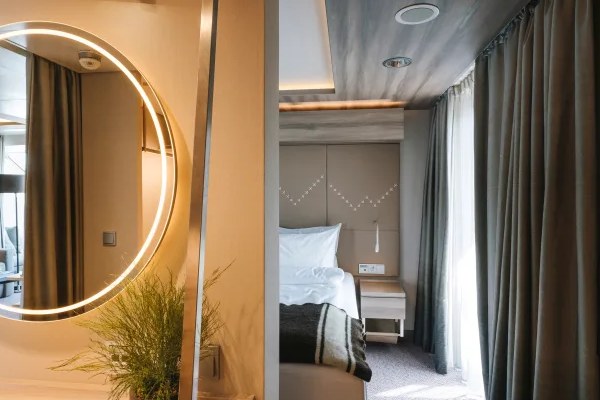
Large Suite
From $11,924 per person
- Large upper-deck corner suite
- Large windows
- Private balcony
- Wheelchair accessible, may be available for general booking
- Seating area
- Double bed (optional twin)
- Double fold-down bed
- Bathrobes and slippers available on request
- Guests: 4

Suite with balcony
From $10,567 per person
- Upper-deck suite
- Private balcony
- Double bed (optional twin)
- Sofa bed or seating area
- Bathrobes and slippers on request
- Guests: up to 4
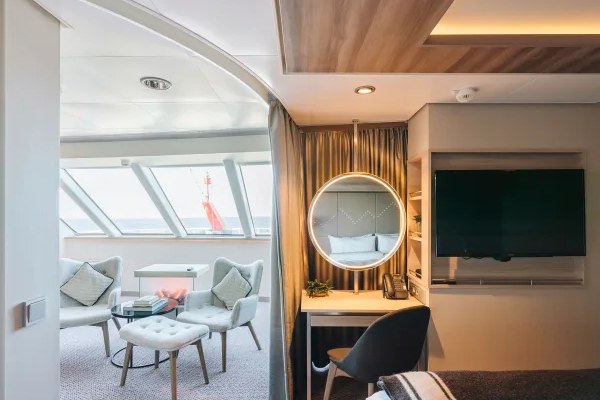
Corner suite
From $10,228 per person
- Upper-deck corner suite
- Large windows
- Seating area
- Double bed (optional twin)
- Bathrobes and slippers on request
- Guests: 2
Terms & Additional Information
All rates are per person, based on double occupancy, valid for North American residents only and are subject to availability and change without notice and voyage only.
All rates are per person, based on double occupancy, valid for North American residents only and are subject to availability and change without notice and voyage only. The ship departure date determines the price of your voyage. Not all cabin grades are available on all ships. Prices for cabin grade D on request.
For voyages 9 nights or longer, cabin assignments are complimentary. For reservations less than 9 nights, guests may reserve specific cabins: $150 per cabin for northbound and $125 per cabin southbound voyages.
Single Supplement: applies and varies based on desired travel date.
Price Does Not Include:
- Flights
- Transfers
- Travel Protection Plan
- Optional Excursions
- Optional Beverage Packages
- Luggage handling
All fares are quoted in US Dollars.